5 Alternatives to ATACLETE for Tactical Athletes

Last Updated: October 30, 2026
Quick Summary
An ataclete alternative is a training approach that builds physical readiness for the job rather than for a single fitness test, matched to your occupation, schedule, and equipment. Score each candidate on occupational specificity, measurable outcomes, equipment footprint, and weekly time cost, and treat any program scoring below 3 on a criterion as a poor fit.
- Patrol officers need 3-4 hours per week with dumbbells and a treadmill or open road.
- Special warfare candidates train 6-8 hours weekly with a barbell, ruck, and pull-up bar.
- A recommended week has two strength days, two conditioning days, one load carriage day, and one recovery day.
- Separate hard efforts by at least 24 hours so strength and ruck pace do not both suffer.
- Track resting heart rate, sleep, soreness, and performance markers weekly to catch recovery problems.
Table of Contents
- What an ATACLETE Alternative Actually Means
- How to Choose: Decision Criteria by Occupation and Goal
- Building a Tactical Athlete Training Program That Fits the Job
- Strength and Endurance Training for Tactical Athletes
- Tactical Athlete Recovery: The Piece Most Programs Skip
- Supplements for Tactical Athletes: What to Verify Before You Buy
- Build Your Own Alternative Stack with Combat Nutra
- Frequently Asked Questions
What an ATACLETE Alternative Actually Means
An ATACLETE alternative is a training approach that builds physical readiness for the job rather than for a single fitness test. According to the Journal of Environmental and Occupational Medicine special issue on tactical athletes, tactical athletes face distinct challenges and rewards that general fitness plans do not account for.
A patrol officer, a wildland firefighter, and a special warfare candidate do not need the same strength standards, endurance base, or recovery plan. Most universal programs optimize for a test, not a job.
Combat Nutra works with military personnel, veterans, and first responders. This guide covers how to pick an alternative by occupation and goal, what to measure, and where recovery and supplements fit.
How to Choose: Decision Criteria by Occupation and Goal
Start with the job, not the program. The right alternative matches your operational demands, so score each candidate against four criteria: occupational specificity, measurable outcome targets, equipment footprint, and weekly time cost.
Matching the Program to the Job
The National Strength and Conditioning Association describes specificity as a core component of tactical training: programs should enhance performance and decrease injuries by mirroring the actual work.
Use this framework to filter options:
| Occupation | Priority Quality | Secondary Focus | Training Time per Week | Equipment Minimum |
|---|---|---|---|---|
| Patrol / law enforcement | Aerobic base, load carriage | Relative strength | 3-4 hours | Dumbbells, treadmill or open road |
| Wildland firefighting | Work capacity, heat tolerance | Leg endurance | 4-5 hours | Pack, stairs or hills, kettlebells |
| Special warfare candidate | Load carriage, grip endurance | Absolute strength | 6-8 hours | Barbell, ruck, pull-up bar |
| Military line unit | Strength-to-bodyweight ratio | Rucking | 4-5 hours | Barbell or sandbag, ruck |
| Detention / corrections | Relative strength, grip | Short-burst conditioning | 3-4 hours | Dumbbells, bodyweight |
If your role is mostly sitting in a vehicle with occasional foot pursuits, a special warfare block will bury you. If you carry 45 pounds of gear up a hill, a bodybuilding split will not prepare you.
Relative Strength vs. Absolute Strength
Relative strength is force produced per unit of bodyweight; absolute strength is total force regardless of weight.
Absolute strength matters for heavy carries and breaching, but it comes at a bodyweight cost. Pick your emphasis based on what the job asks for. For the full breakdown of this role, read what is a tactical athlete army h2f before committing to a program.
Measurable Outcome Targets by Role
The gap most alternatives leave open is what to measure. Use these benchmarks as a starting filter, the metrics a credible tactical program should improve:
If a program cannot tell you which of these it improves and by how much, it is general fitness with a camouflage label.
Equipment and Accessibility Filters
Equipment access is the second filter. A program requiring a full barbell setup is useless to a firefighter on a station rotation with dumbbells and a stairwell. Confirm the program offers a minimal-equipment track, a substitution list for every lift, and a conditioning option that works in a hotel gym, station bay, or parking lot.
Program Modifications for Age, Experience, and Injury History
A 22-year-old special warfare candidate and a 42-year-old patrol sergeant should not run the same block. Look for beginner, intermediate, and masters tracks with explicit deload and injury-substitution guidance. If a program only has one track, assume it is built for the youngest, healthiest athlete in the room.
A Quick Scoring Rubric
Score each alternative from 1 to 5 on occupational specificity, measurable outcomes, equipment flexibility, and modification options. A program scoring below 3 on any criterion is a poor fit regardless of its marketing.
Building a Tactical Athlete Training Program That Fits the Job
A tactical athlete training program works when it is built backward from the job. Write down the five hardest physical tasks your role demands, then train those patterns.
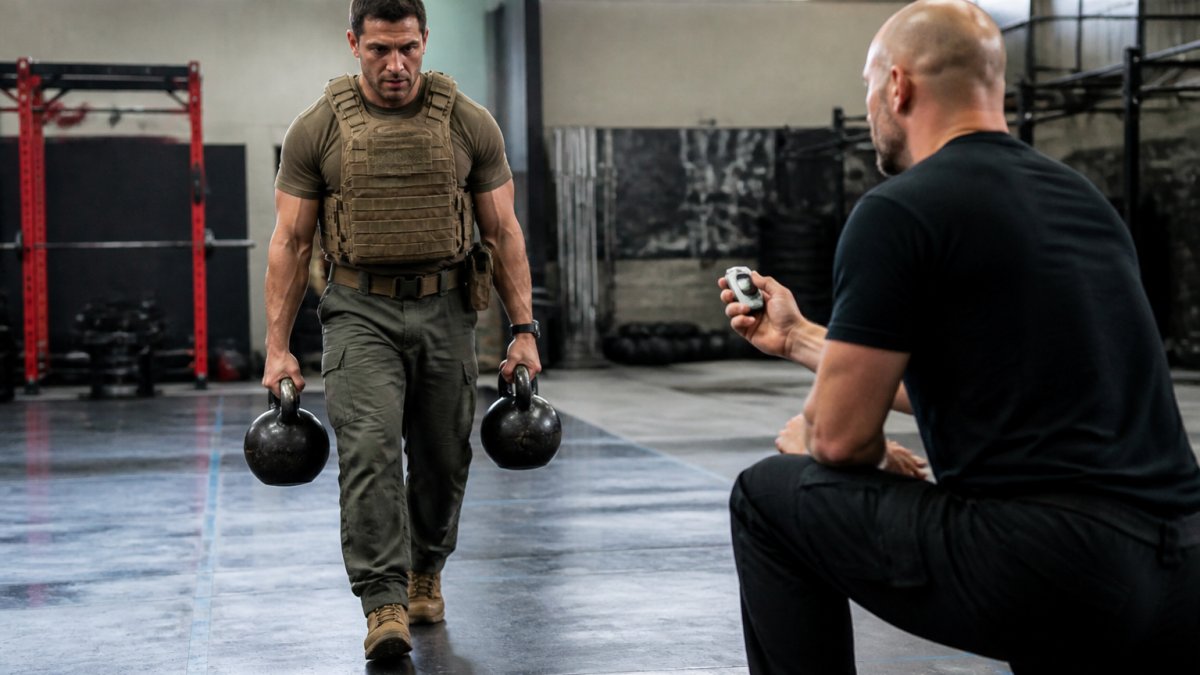
Here is the structure we recommend:
- Two strength days: squats, hinge lifts, push presses, and loaded carries. Keep reps low and controlled.
- Two conditioning days: running, incline treadmill, rowing, or stair climbing, depending on equipment access.
- One load carriage day: rucking or plate carrier work, progressed gradually.
- One recovery day: mobility, easy aerobic work, sleep priority.
A common mistake is stacking conditioning on top of strength work with no plan for fatigue, so your squat session and ruck pace both suffer.
Plan around shift work too. A night-shift officer should not schedule max-effort squats at 6 a.m. after a 12-hour rotation; move the heavy day to the start of your off block.
Strength and Endurance Training for Tactical Athletes
Strength and endurance training for tactical athletes should build both qualities without letting one erase the other. The interference effect is real: heavy endurance volume blunts strength gains when the two are stacked carelessly.
The fix is sequencing and volume control: lift first in a session, run second, keep hard endurance work to two or three sessions per week, and fill the rest with low-intensity aerobic work.
Work Capacity, Load Carriage and Conditioning
Work capacity is the ability to repeat demanding tasks without breaking down, the fourth flight of stairs, the second drag, the third hour on a fire line.
Conditioning options by equipment access:
- Full gym: incline treadmill walking, rowing intervals, stationary bike
- Minimal equipment: stair climbing, bodyweight circuits, controlled movement drills
- Field setting: rucking, hill repeats, loaded movement carries
Load carriage deserves its own progression. For evidence-based guidance on how often to ruck, progression, and pack fit, see our ruck march training plan.
Cross-training matters here: elliptical and bike work build aerobic capacity with less impact, keeping you training when running volume would otherwise cause problems.
Tactical Athlete Recovery: The Piece Most Programs Skip
Tactical athlete recovery is where most programs quietly fail. Training breaks you down; recovery makes the adaptation stick. Skip it and you get a tactical athlete who tests well once and then spends a month rehabbing.
Recovery for tactical athletes differs from general fitness. Shift work, heat exposure, and load carriage add stressors a standard deload week does not address, so recovery has to be scheduled around the job, not the gym.
Sleep: The First and Least Negotiable Lever
Shift work wrecks sleep, so protect the block you can control. A practical protocol:
Nutrition and Hydration for the Job
Nutrition is second: enough protein, enough total calories, and hydration that accounts for heat and gear weight. Under-eating on shift and over-caffeinating to compensate is a common pattern. Aim for a protein source at every meal, and on hot shifts add an electrolyte source rather than plain water alone.
Recovery Modalities Worth the Time
- Easy aerobic work on off days to move blood without adding fatigue, 20-30 minutes at a conversational pace.
- Mobility work targeted at hips, shoulders, and ankles, especially after load-carriage days.
Recovery Markers to Track
Recovery is measurable, and alternatives that skip it leave athletes guessing. Track these weekly:
- Resting heart rate: a rising trend over baseline suggests accumulated fatigue.
- Sleep duration and quality: a simple 1-5 rating each morning is enough.
- Soreness: rate each major joint and muscle group 1-5; persistent 4s and 5s mean the program is outpacing recovery.
- Performance markers: if your squat or ruck pace drops for two consecutive sessions, treat it as a recovery problem before a programming problem.
Role-Specific Recovery Adaptations
- Law enforcement: recovery is dominated by shift scheduling. Place the hardest training day at the start of an off block, not after a night rotation.
- Firefighting: heat exposure is the hidden stressor. Prioritize rehydration and cool-down after live-fire or training evolutions, and treat the day after a heavy fire day as a recovery day.
- Military line units: field time compresses recovery. Build in a deload after every field exercise, and do not stack a max-strength test on the first day back.
- Older athletes: recovery capacity declines before strength does. Extend deload frequency to every third week if you are over 40 and notice slower recovery between sessions.
Medical Oversight as Part of the Program
The American College of Cardiology and American Heart Association guidance on tactical athletes introduces a framework combining evidence-based medical care with occupational demands, including cardiovascular risk and fitness-for-duty assessment. That is the standard to aim for: recovery and medical oversight treated as part of the program, not an afterthought. For a deeper look at recovery and longevity options, see our guide to the best peptides for recovery and longevity.
Supplements for Tactical Athletes: What to Verify Before You Buy
Supplements for tactical athletes are a crowded, poorly regulated shelf. The label claim is not the proof, verify before you spend.
What to check on any product:
- Third-party testing: a named lab and a certificate you can look up, not a badge graphic
- No proprietary blends: every ingredient and dose listed
- Dosing that matches the research, not sprinkles of expensive ingredients
- Manufacturing standards: facilities meeting current Good Manufacturing Practice requirements
Trusting "third-party tested" as a phrase means little without a named lab and batch-level documentation. Our guide on how to verify supplement third-party testing shows how to check these claims before you buy.
Buying supplements from brands that do not disclose ingredients and doses can mean under-dosed actives or unlisted stimulants.
Build Your Own Alternative Stack with Combat Nutra
At Combat Nutra, our supplements are Made in the USA, third-party tested with no proprietary blends, and manufactured in facilities that meet current Good Manufacturing Practice standards. You can also build your own stack with pre-workout, creatine, whey and daily essentials.
The hardest part of tactical fitness is finding a program that matches your job, hours, and recovery capacity, then staying consistent long enough to see results.
Frequently Asked Questions
What is ATACLETE and why would I need an ataclete alternative?
ATACLETE is a tactical fitness brand built around training programs for military, law enforcement and first responders. People look for an ataclete alternative for a few reasons, such as a program that does not match their occupation or a need for recovery and supplement support. Before switching, define what you actually need: a training plan, a recovery protocol, or a nutrition and supplement system. Most people need all three, and few single platforms deliver each one well.
How do I choose a tactical athlete training program?
Start with the physical demands of your job, not a generic template. Training should mirror the tasks you perform, so a wildland firefighter and a patrol officer should not run identical blocks. Then check three things: does the plan include strength work built on squats, hinge lifts and push presses; does it build work capacity through load carriage and conditioning; and does it schedule recovery rather than treating it as optional. Ask for a written sample week before you pay.
Can tactical athletes build strength and endurance in the same program?
Yes, but the mix has to be deliberate. Strength and endurance training for tactical athletes compete for recovery, so most programs pair heavy barbell work with low-intensity aerobic work such as long slow distance, incline treadmill walking, rowing or stationary bike sessions. Keep hard conditioning days away from your heaviest lifting days. If your aerobic capacity is already strong, protect the strength work; if you struggle on loaded movements, protect the conditioning. Review the balance every four to six weeks.
What should tactical athletes look for in a supplement program?
Look for third-party testing, no proprietary blends, and a label that states every ingredient and dose. Proprietary blends let a manufacturer hide under-dosed ingredients behind a single number. For tactical athletes, the priority is recovery and consistency rather than stimulant load, since sleep and job performance matter more than a pre-workout rush. Combat Nutra products are Made in the USA and manufactured in facilities that meet current Good Manufacturing Practice standards.
